Planning a Destination Wedding from the US, UK, Canada or Australia: Everything You Need to Know
The couples who choose to marry in Provence from the other side of the world are not people who shy away from complexity. They are people who understand that the most extraordinary experiences require a certain leap of faith — and who have the wisdom to take that leap with the right support.
The majority of couples I work with are based in the United States, the United Kingdom, Canada or Australia. None of them have planned a wedding in France before. Almost all of them arrive at our first conversation with the same question: is this actually possible to do from where we are?
It is not only possible. With the right structure and a trusted local team, it is one of the most enjoyable planning processes my couples have been through. Here is exactly how it works.
The Legal Reality: Getting Married in France as a Foreign National
I want to address this early because it is the question that creates the most anxiety — and the most unnecessary anxiety. Many international couples choose a symbolic or blessing ceremony in France rather than a legal ceremony. This is extremely common and requires no French administration whatsoever. You legalise your marriage at home — at a registry office in London, a courthouse in New York, a civil celebrant in Sydney — and then celebrate your union in Provence with the ceremony and celebration of your dreams.
For couples who do wish to legalise their marriage in France, can be possible but requires significant advance preparation: a minimum of 40 days of residency in the commune, translated and apostilled documents, and coordination with the local city hall. I guide couples through this process when it is their preference, but it is worth knowing that the symbolic route is equally meaningful, legally sound at home, and dramatically simpler.
A Church Ceremony in France: Is It Possible for Foreign Couples?
This is one of the questions I receive most often from Catholic couples — and the honest answer is: yes, it is possible, but it requires careful preparation and the right approach to finding a church willing to welcome you.
The fundamental rule: civil marriage must come first
In France, a Catholic church ceremony has no legal standing whatsoever. French law recognises only the civil ceremony conducted at the city hall as legally binding — religious ceremonies of any denomination are considered symbolic under French law. This means that before you can marry in a French church, your civil marriage must already have taken place — either at your local town hall or registry office at home, or through the full French civil process described above.
The faith requirements
French Catholic churches are not event spaces that can be hired for their architectural beauty. They are active parishes, and the priests who receive couples are genuinely concerned with the sacramental dimension of the ceremony. Before anything else, the following conditions must be met:
At least one partner must be baptised and confirmed in the Catholic faith
Neither partner can be previously married in the eyes of the Church — unless the previous marriage has been formally annulled
Both parties must be free to marry of their own volition
The couple must be willing to complete a marriage preparation process — typically a series of meetings with a priest, which can often be conducted in your home country and transmitted to the French parish
It is worth saying clearly: French priests have encountered many couples who wish to marry in a beautiful Provençal chapel primarily for the photographs. They recognise this immediately, and they decline. If your faith is genuine — if this ceremony carries real spiritual meaning for you — that will come through in your first conversation with the parish, and the experience that follows will be extraordinary.
Finding a church that will welcome you
This is where local knowledge matters enormously. Not all churches in the South of France accept non-resident couples, and those in the most photographed, most tourist-frequented locations are often the most restrictive — precisely because they receive the highest volume of purely aesthetic requests.
There are, however, a handful of churches in Provence and on the French Riviera that genuinely welcome international Catholic couples with open arms, provided the faith requirements are met. These are not always the most famous or most photographed chapels — sometimes they are smaller, quieter, deeply beautiful places that feel entirely right for an intimate ceremony.
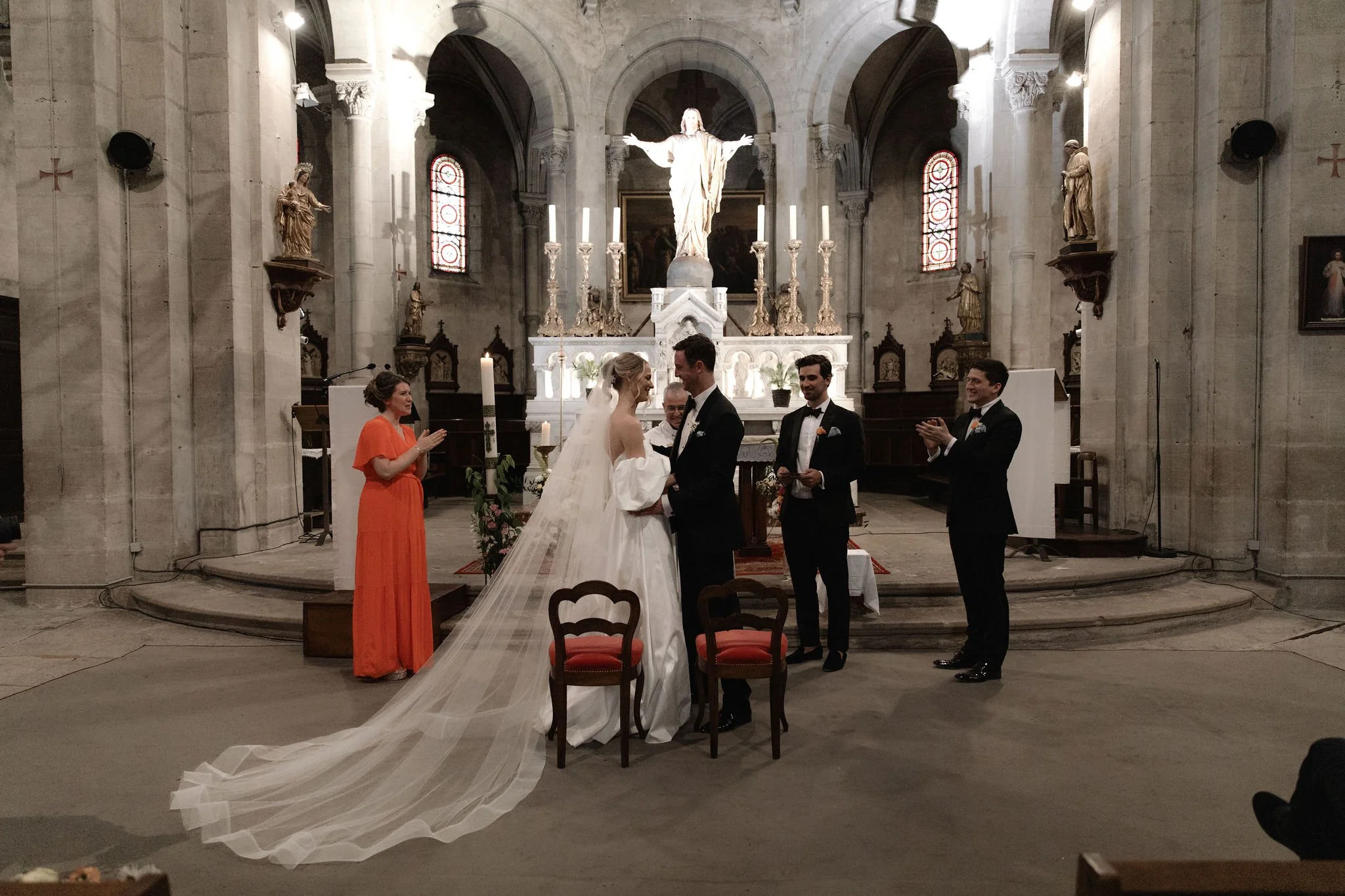
Stephan & Nakita photography - Couple from London who get married in the church of Mazan, Provence
What documents you will need
The required documentation varies slightly by diocese and parish, but as a general framework, you should prepare:
Baptismal certificates for both partners, issued within the past six months (timing matters — check the validity window carefully)
Confirmation certificates
Your civil marriage certificate — from your home country, translated into French
A letter of freedom to marry (“certificat de liberté”) from your home diocese or parish priest, confirming there is no canonical impediment to the marriage
Proof of completed marriage preparation (Pre-Cana or equivalent), which can often be completed at your home parish and transferred
In some cases: a letter from your own parish priest confirming he knows of no reason you should not marry
I cannot stress enough the importance of starting this process early. Twelve months minimum is my recommendation for a church wedding in France. Documents have validity windows. Parishes have limited availability. Marriage preparation takes time. Everything is manageable — but nothing can be rushed.
The ceremony itself
A Catholic wedding in a French church follows the universal liturgical structure — processional, welcome, readings, vows, rings, nuptial blessing, and closing. Depending on whether both partners are Catholic, you may choose between a full Nuptial Mass (with Communion) or a Liturgy of the Word, which is slightly shorter and often more appropriate for mixed-faith couples or those with non-Catholic guests.
What makes a French church ceremony singular — beyond the setting — is the centuries of accumulated meaning in the space itself. These are not new buildings. A Provençal chapel may have witnessed weddings for five hundred years. Marrying in one, with the scent of old stone and candle wax, the light falling through Romanesque windows onto the people you love most, is an experience that no château terrace or lavender field can replicate. For couples for whom faith is genuinely central, it is the most profound way to begin a marriage.
My honest advice: if a church ceremony is important to your faith, pursue it. It requires more preparation than a symbolic ceremony but it is achievable, and the experience is unlike anything else. If you are drawn primarily to the aesthetic of a French chapel, I would gently steer you toward a beautifully designed ceremony in a private estate or historic venue — the result will be just as extraordinary, and far less complicated.
The Planning Timeline From Abroad
Here is the framework I use with most of my international couples:
18 months before the wedding
Initial consultation (video call). We establish your vision, your guest count, your budget, and your preferred dates. I begin venue sourcing and send you a curated shortlist with detailed comparisons and pricing.
12–18 months before
Your first visit to Provence — typically 2 to 3 days. We do venue site visits together, you taste 2 caterers, and we confirm your venue and begin building your vendor team. This trip is intensive but enormously productive, and almost every couple I have worked with describes it as a highlight of the planning process.
9–12 months before
Remote planning intensifies. Design direction is established. Vendor contracts are reviewed and signed. The guest logistics framework is built — accommodation blocks, travel information, the welcome communication that goes out to your guests. I manage all vendor communication in French; you receive updates in English.
6 months before
A second optional visit for design review — tasting menus/cake, floral mock-ups, tablescaping. Many couples combine this with a holiday in the region, which I highly recommend. Seeing your venue in the same season as your wedding date, with local restaurants and markets, brings the vision to life in a way that no mood board can replicate.
Final weeks
You arrive in Provence. Your only job is to be present, to enjoy the region with your families, and to trust that everything is managed. My team handles all vendor logistics, day-of coordination, and the thousand small decisions that happen in the hours before and during a celebration. You will not be solving problems on your wedding day.
Tools and Communication
I work with a shared planning platform that gives you real-time visibility of your budget, your vendor list, your timeline, and every document related to your wedding — accessible from anywhere in the world at any time. No email archaeology, no spreadsheets emailed back and forth. Everything in one place.
Video calls are our primary communication tool, and I schedule them thoughtfully to respect time zones. A couple in Los Angeles, a couple in London, and a couple in Melbourne all receive the same quality of attention — the structure simply adapts to the time difference.
What You Do Not Need to Manage
One of the greatest gifts of working with a full-service local planner is the list of things that simply disappear from your plate. You do not need to translate vendor contracts, navigate French administrative systems, chase caterers for menu confirmations, coordinate shuttle timings between seven hotels, or manage the logistics of a 90-person guest list across three countries. These are my domain entirely. You are free to focus on the parts of your engagement that are joyful.
The couples who come to Provence from thousands of miles away, who trust the process, and who arrive on their wedding day with their families gathered around them — these are the celebrations I am most proud of. Distance is not an obstacle. It is simply a design parameter, and one I am very practiced at working with.