Food & Wine: How to Plan a Menu That Does Justice to the South of France
I have never met a couple who chose the South of France for its weather alone. They come for the light, yes. For the landscapes and the ancient stone. But underneath all of it, is the food & wines.
Nowhere in the world does the relationship between a landscape and its cuisine feel as direct as it does in Provence and France. The olive oil pressed from trees that have been standing for three hundred years. The tomatoes that taste like the thing tomatoes are trying to be everywhere else. The wine made two hundred metres from the table where it will be served. Planning the food and wine for a wedding here is not a logistical exercise — it is an act of creative expression, and one I take very seriously.
The Philosophy: Let the Region Lead
The most common mistake I see with wedding menus — not just in France but everywhere — is designing the food to be impressive rather than resonant. Grand gestures, elaborate constructions, menus that could exist in any country in the world. In the South of France, this is a particularly unfortunate choice, because what the region offers is already extraordinary. My role is to help you access it.
A menu rooted in Provence will feature ingredients that are seasonal, local, and at their peak at the exact moment of your celebration. A July wedding might feature “ratatouille” pressed into an architectural “terrine”, roasted lamb from the Alpilles with herbs picked that morning, and a dessert built around the “gariguette” strawberries that appear for just a few weeks each summer. This is not rusticity — it is the highest expression of French cuisine.
The Structure of a South of France Wedding Menu
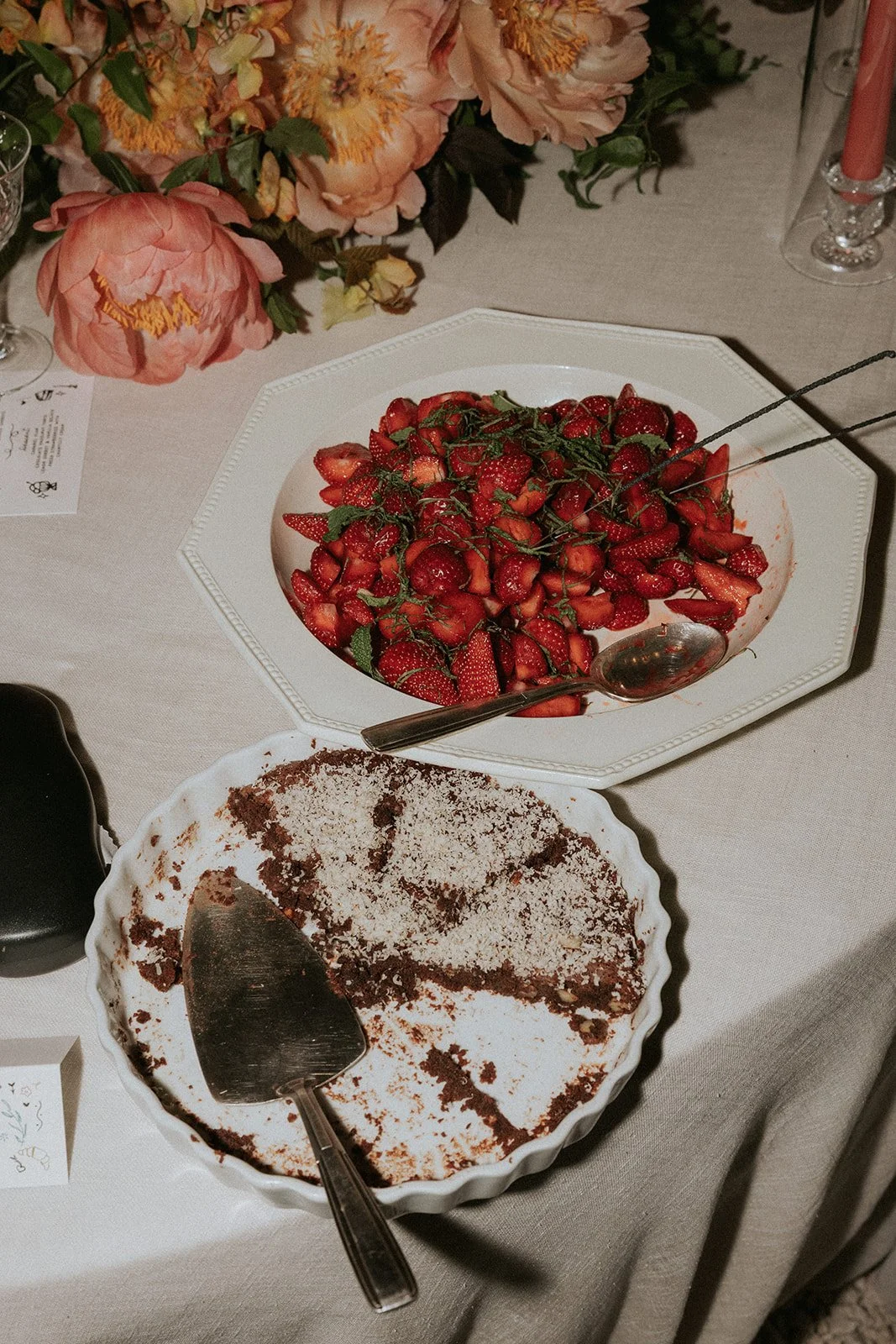
Bernadeta Kupiac photo - Homemade french desserts to replace the “wedding cake”, sharing at table, family style
French wedding dining is unhurried and sequential. Here is the framework I work within:
“Vin d'honneur” canapés — typically 8 pieces per guest, showcasing local produce: “tapenade” on toasted “pain de campagne”, mini “socca” with fresh goat's cheese, anchovy-stuffed peppers, “charcuterie” from a local artisan. Plus 1 or 2 food station: ham cutting, “fois gras” station, truffle shaves with bread and butter…
“Amuse-bouche” — a single elegant bite at the table to signal the transition from cocktail energy to dinner. Often a cold summer soup or a small composed plate
Starter (optional if the cocktail is a long one and more than 10 pieces/pers) — frequently a vegetable-forward plate in summer, or a more composed seafood dish for coastal venues on the Riviera
Fish course (optional) — a lighter interlude between starter and main, often based on Mediterranean fish: “daurade”, “loup de mer”, “rouget”
Main course — typically lamb, beef, or duck, roasted and served with a sauce that has been developing since morning. Vegetarian alternatives are designed with the same care, not as afterthoughts
Cheese — this is France, and a cheese course is non-negotiable or it can be displayed on a buffet for late night cravings. A selection of regional cheeses — “Banon” wrapped in chestnut leaves, a sharp “Pélardon”, a creamy “Saint-Nectaire” — served with honey and walnut bread
Dessert and wedding cake — the pastry moment. Often a combination of a mignardise platter, individual desserts, and the wedding cake or croquembouche
Wine: The Other Half of the Conversation
Provence produces some of the finest rosé wine in the world — not the pale, fashionable rosé that fills supermarket shelves globally, but serious, gastronomic wine with genuine complexity and extraordinary food affinity.
I work with a wine merchant who know almost all wine producers in the region (and France), including domaines that will pour their wine at your dinner and whose bottles can become part of your welcome gift to guests. There is something deeply right about drinking wine made in the same landscape where you are being married.
Beyond rosé, Provence offers serious Grenache-based reds from the Ventoux and Luberon appellations, and a small but exceptional production of white wines — particularly from Cassis, 40 minutes from Marseille, where the limestone terroir produces some of the most distinctive white wine in France.
Working With Your Caterer: What the Process Looks Like
I work exclusively with caterers I trust completely — not simply those with impressive websites, but those whose kitchen teams I have stood alongside, whose sourcing practices I understand, and whose service staff I have watched work through an 10-hour reception. The tasting process is one of the genuinely pleasurable elements of wedding planning: typically held 9 to 12 months before the wedding, in Provence, where you will spend at least 2.5h eating and drinking with your caterer and shaping your menu together.
Dietary requirements are managed with care and without the usual compromise. A guest who does not eat meat at a South of France wedding should not receive a sad vegetable plate. They should receive a menu designed around the extraordinary vegetables that this region produces — just as considered, just as beautiful as the plates on either side of them.
The table is where the celebration lives, especially for us, French people. It is where the speeches happen, where old friends find each other, where your grandmother and your college roommate end up in a 2-hour conversation about nothing in particular. A table set in the South of France, with wine that belongs to the soil it came from, is one of the finest gifts you can give the people you love most.